
Entity Formation in the U.S Choosing the Right Business Structure for Global Expansion

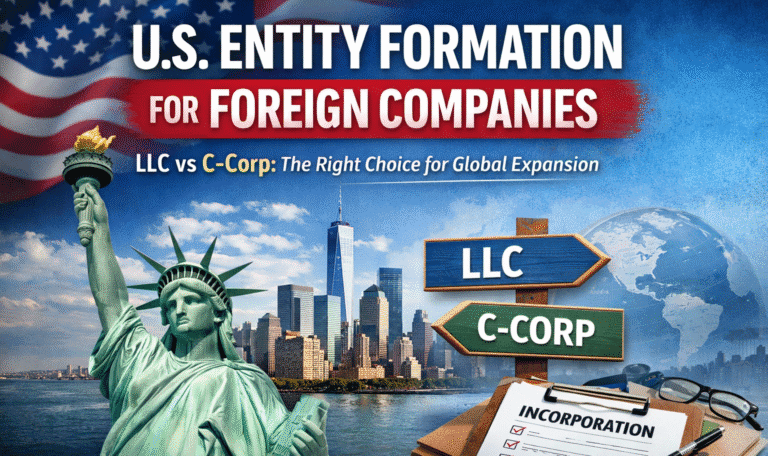
When the Wrong Entity Blocks the Right Investors In 2024, a Singapore-based fintech startup incorporated as a Delaware LLC to quickly launch in the U.S. Everything seemed smooth—until they pitched American venture capitalists. Every investor turned them down for one reason: “We only invest in Delaware C-Corps.” The founders spent six months and $50,000 restructuring, delaying their funding round. Their technology was ready, but the wrong entity choice nearly cost them their U.S. expansion. The Strategic Blueprint: LLC vs. C-Corp vs. S-Corp Decoded Understanding the nuances of American business structures is the first step toward mitigating risk and optimizing for growth. The landscape is dominated by three primary entities, each with distinct advantages for foreign owners. The Limited Liability Company (LLC) remains the most popular structure for foreign entities, representing over 42% of all new business formations with foreign ownership in 2024. Its appeal lies in its flexibility: profits and losses can “pass through” to the owners’ personal tax returns, avoiding the double taxation faced by C-Corporations. This makes it ideal for holding companies, real estate investments, and small to medium-sized businesses where the primary goal is asset protection and straightforward profit distribution. However, a significant limitation for high-growth startups is that most venture capital firms and institutional investors require a Delaware C-Corporation for investment. The C-Corporation is the engine of scalable, venture-backed innovation. While it subjects profits to corporate tax and shareholder dividends to a second layer of tax, it offers unparalleled advantages for raising capital. The structure allows for an unlimited number of shareholders and multiple classes of stock, which is essential for complex funding rounds. In 2025, over 78% of VC-funded startups in the U.S. were Delaware C-Corps. For foreign entrepreneurs planning to seek significant U.S. investment, this is often the only viable path. The S-Corporation, while offering pass-through taxation, is generally not an option for foreign owners as it prohibits non-resident alien shareholders. This critical restriction makes it essential to focus on the LLC vs. C-Corp decision tree from the outset. Beyond Delaware: Selecting Your Strategic U.S. Footprint The choice of state for incorporation is as strategic as the choice of entity itself. While Delaware is renowned for its business-friendly courts and well-established corporate law, handling over 68% of all Fortune 500 companies, it is not always the optimal choice for every international business. Emerging hubs like Wyoming and Nevada are gaining traction due to their enhanced privacy protections, no state corporate income tax, and simplified compliance requirements. Wyoming, for instance, saw a 55% year-over-year increase in new business applications from foreign entities in 2024, largely attributed to its robust LLC asset protection laws. These states can be ideal for businesses focused on e-commerce, digital services, or asset holding where physical operations may be minimal. However, if your business plan involves a physical office, employees, or significant sales within a specific state, you will likely need to register as a “foreign entity” in that state anyway. This means a company operating in Texas, even if incorporated in Delaware, must qualify to do business in Texas and will be subject to Texas state taxes and reporting. The decision, therefore, must balance legal advantages with operational reality. Recent data shows that 34% of foreign-owned LLCs now choose their primary operational state for incorporation to simplify compliance, a 12% increase from 2022. From Formation to Funding: The 90-Day Activation Blueprint A legally formed entity is just the starting point. The true test lies in activating it within the U.S. financial and legal ecosystem, a process where many international founders stumble. The single greatest hurdle is securing a U.S. business bank account. Post-2024, banking regulations have tightened, with most major institutions requiring at least one U.S-based signatory or a robust U.S. credit history. Specialist financial services that cater to international clients have emerged to fill this gap, but due diligence is paramount. Simultaneously, understanding tax compliance from day one is non-negotiable. For example, even a single-member LLC owned by a foreign person must file an IRS Form 5472, with penalties for non-compliance starting at $25,000. The timeline for activation is critical. A well-executed plan can secure an Employer Identification Number (EIN), open a bank account, and establish initial compliance within 45-60 days. Delays here can stall contract signings and payroll setup. Case in point: a Canadian tech firm we advised leveraged their newly formed Delaware C-Corp to secure a $2M seed round because their banking and cap table were investor-ready from day one, shaving 3 months off their funding timeline. The Global Founder’s Checklist: Your First 5 Steps Your First U.S. Business Decision Could Be Your Most Important Choosing your U.S. business structure is a decision that reverberates through every aspect of your expansion—from taxation and liability to your ability to attract capital. The entrepreneurs who succeed are those who treat this decision not as a mere legal formality, but as a core component of their global strategy. Your next step is to move from consideration to consultation. In our next article, we will deconstruct the intricacies of U.S. banking and payment solutions for foreign entities. To ensure your foundation is solid, begin by mapping your strategic goals against the frameworks outlined here. JURIS CONSULTANTS U.S. EIN requirements for foreign companies U.S. compliance for foreign-owned businesses speak with a U.S. entity formation expert Ritu
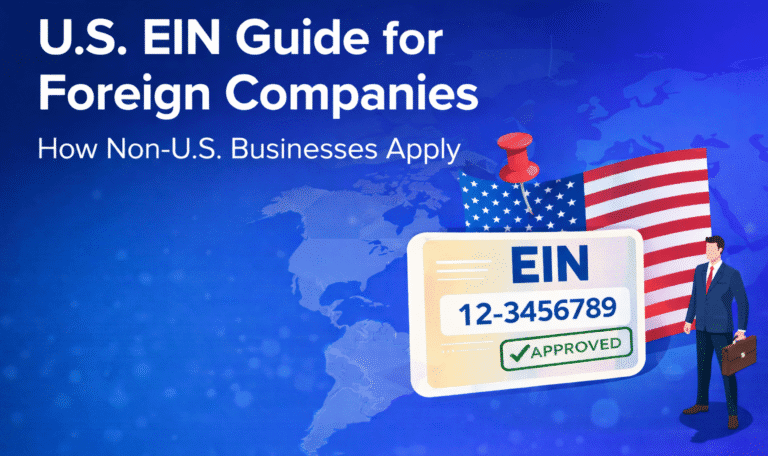
U.S. EIN Guide for Foreign Companies: How Non-U.S. Businesses Get an Employer Identification Number

The Nine-Digit Key That Can Make or Break Your U.S. Expansion When London-based fintech Wise expanded into the U.S., one of its first hurdles wasn’t customers but securing an IRS Employer Identification Number (EIN) to open bank accounts and hire staff. Now, imagine you land a $500,000 U.S. client deal—you incorporate an LLC, but the bank halts you with, “You need an EIN.” This isn’t uncommon; in 2024, U.S. monthly business applications averaged 430,000, nearly 50% higher than 2019. Without that nine-digit key, your U.S. operations can stall while competitors’ race ahead. Why Foreign Companies Need a U.S. EIN  A tax key to unlock U.S. business operations An Employer Identification Number (EIN)—also called a Federal Tax Identification Number—is the mechanism by which the Internal Revenue Service (IRS) tracks business tax filings, compliance, and withholding obligations. It functions like a Social Security Number for corporations, enabling a foreign company to satisfy U.S. legal, banking, payroll, licensing, and taxation requirements. Even foreign entities must secure one if engaging in U.S. business operations. Failing to have an EIN creates major friction, as it prevents you from legally hiring U.S. employees and reporting payroll withholdings, restricts your ability to open a U.S. bank account since most financial institutions require an EIN, and may block access to U.S. vendor networks, marketplaces, or funding opportunities. Additionally, without an EIN you risk delays or penalties in filing essential IRS forms such as Form 1120, Form 941, and other required tax filings. Trends & data that reflect urgency The U.S. is in the throes of a business boom. In 2023, approximately 5.5 million new businesses launched—breaking all prior records. Moreover, projected business formations in August 2025 stood at 28,725 and rose 0.8% compared to July. In a crowded and accelerating landscape, any administrative delay—like not having an EIN—can mean losing clients, talent, or market positioning. In the broader small business ecosystem, the U.S. is home to ~36 million small enterprises, accounting for nearly half of private sector job creation. Between March 2023 and March 2024, 1.1 million new firms opened, adding 1.2 million jobs. That means competition for opportunity and capital is intense. A foreign entrepreneur armed with an EIN can move faster, onboard seamlessly, and integrate into the U.S. economy with fewer obstacles. Missing administrative accessMany non-U.S. founders mistakenly believe they can postpone getting an EIN, but the reality is different—without it, you’ll quickly run into roadblocks the moment you try to open a U.S. bank account, set up payroll, or apply for essential licenses. Securing your EIN early eliminates these hurdles and keeps your operations running smoothly, so it’s wise to begin the EIN process as soon as you incorporate your U.S. entity, whether an LLC or a corporation, rather than waiting for your first client or contract. This proactive approach ensures your business can operate without unnecessary delays and positions you to take advantage of opportunities from day one. Navigating the EIN Application Landscape Methods foreign entities can use While U.S.-based entities can obtain an EIN immediately online using the IRS’s EIN Assistant, foreign entities cannot use this portal and must instead apply through alternative methods. When completing Form SS-4, foreign applicants must note: Expert insight & case study A cross-border SaaS founder in India used a U.S. registered agent to fax their SS-4, and the IRS issued an EIN in 3 days. With their EIN in hand, they opened a U.S. bank account, launched on Stripe, and leveraged U.S. payment rails within two weeks—far faster than most. Accountants and international formation services recommend preparing supporting documentation (e.g. certificate of incorporation, proof of address, board resolution) ahead of time.  Confusing IRS instructionsMany foreign entrepreneurs freeze at Box 7 or Box 9’s NAICS classification. Outsourcing prep to a tax advisor or formation service often avoids rejections or delays. Methodology framework: From EIN to Execution — What You Do Next (200-250 words) Post-EIN operational steps Once you receive your EIN (it never expires, unless business structure changes), you unlock several capabilities: A practical challenge is coordinating state-level registrations. Even with your EIN, states may require qualification (e.g. foreign LLC registration, registered agent, state withholding account). Also, aligning your EIN to your U.S. FEIN, filings, and global tax obligations is not trivial. Looking ahead, emerging regulatory pressures include the Corporate Transparency Act (CTA). Though earlier enforcement was enjoined, as of January 2025, Treasury resumed enforcement focusing on foreign reporting companies—those formed outside the U.S. and doing business within.  Ensure you maintain beneficial ownership data and compliance readiness. Moreover, new proposals such as Section 899 of the One Big Beautiful Bill Act (if enacted) could target foreign-parented companies with additional tax burdens. As foreign investors assess U.S. exposure, having clean EIN and compliance posture becomes a competitive shield. Complying across levelsMany foreign businesses assume EIN alone solves compliance. In reality, EIN is just the key; you must integrate it into federal, state, payroll, and local systems.  From Paperwork to Power: A Practical EIN Application Toolkit Here’s a compact, actionable toolkit you can implement right away. Start by preparing your entity documents, such as the Certificate of Incorporation, company address, and business purpose. Next, complete Form SS-4 using the foreign applicant version—enter “Foreign” in the SSN/ITIN field and designate the responsible party correctly. Once ready, choose your application route: phone, fax, or mail. If faxing, include a return fax number to speed up processing. After submission, track your application and verify EIN issuance by reviewing the official IRS confirmation letter (CP 575). Finally, apply your EIN across all essential areas—banking, payroll, licensing, and state registrations—to fully activate your U.S. business operations. Turning Nine Digits into Global OpportunitySecuring an EIN may feel like a small administrative step, but for foreign entrepreneurs, it’s the nine-digit gateway to unlocking the U.S. market. With it, you gain access to banking, payroll, licensing, and compliance systems that allow your business to compete on equal footing with domestic players. In today’s fast-moving landscape, the companies that prepare early are the ones that scale faster and..

Market Research Mastery: How to Read America Like a Local Before You Arrive

Last month, a successful fintech entrepreneur from London invested $75,000 launching what appeared to be the perfect digital banking solution for American millennials. Within four months, he was shuttering operations—not because his technology was inferior, but because he fundamentally misunderstood how American consumers approach financial services differently than their European counterparts. His failure wasn’t in execution; it was in research. Don’t let this become your story. The American Consumer Psychology Decoded Understanding American consumers requires recognizing that the United States isn’t a single market—it’s 50 distinct markets with unique regional preferences, cultural triggers, and purchasing behaviors. Recent data from the U.S. Census Bureau shows that business formation patterns vary dramatically by region, with states like Wyoming experiencing 56% year-over-year growth while others maintain steady baseline levels. These variations reflect deeper consumer psychology differences that can make or break your market entry strategy. Regional purchasing power disparities create distinct opportunity zones that most international entrepreneurs completely overlook. While California and New York dominate headlines, states like Colorado, Minnesota, and Oklahoma are experiencing business formation surges of 34%, 21%, and 41% respectively. These emerging markets often present less competition and higher success rates for well-researched international entries. The post-pandemic American consumer has fundamentally shifted priorities, with 60% of entrepreneurs now prioritizing social and environmental impact above profitability. This represents a massive departure from traditional profit-first mentalities and creates entirely new market segments for purpose-driven businesses. Understanding these value shifts is crucial for positioning your products and services effectively. Cultural triggers that drive American purchasing decisions operate differently across demographic segments. The rise of the gig economy has created 97 million AI-related job opportunities by 2025, fundamentally changing how Americans view employment, financial security, and business relationships. Entrepreneurs who understand these underlying psychological shifts can position their offerings more effectively than competitors still operating from outdated consumer models. Research Tools the Pros Use Professional market researchers rely on a sophisticated toolkit that most international entrepreneurs never discover. The U.S. Census Bureau’s Business Formation Statistics provide real-time weekly data on new business applications, revealing market momentum before it becomes obvious to competitors. This data, combined with Federal Reserve economic indicators, creates a predictive framework for identifying emerging opportunities. Industry-specific intelligence platforms offer  deeper insights than general market research. The Bureau of Economic Analysis tracks foreign direct investment flows by industry and geographic region, showing exactly where international capital is flowing and why. In 2024, manufacturing affiliates attracted the largest increase in foreign investment, led by computer and electronic products manufacturing. This granular data helps international entrepreneurs identify which sectors offer the greatest opportunity for new entrants. Government databases that most entrepreneurs miss include the Small Business Administration’s lending data, which reveals which industries and regions are receiving increased capital support. Recent analysis shows small businesses created 71% of net private job gains since 2019, with startups alone contributing 26% of total new job creation. These metrics indicate which sectors have the strongest growth momentum and government support. Local competitor analysis requires understanding that American businesses operate with different financial structures and growth expectations than international counterparts. U.S. businesses increasingly prefer S-corporations and LLCs, representing 39% and 34% of business structures respectively. This preference reflects tax optimization strategies and operational flexibility that international competitors must understand to compete effectively. The 30-Day Market Intelligence Blueprint Week 1: Foundation ResearchBegin with macroeconomic data collection using Federal Reserve economic indicators and Census Bureau business formation statistics. Focus on your specific industry’s growth trajectory over the past 24 months, paying particular attention to regional variations. The artificial intelligence sector’s 75.6% funding surge in early 2025 demonstrates how quickly market conditions can shift. Identify the top 10 direct competitors in your target geographic markets, analyzing their business structures, pricing models, and customer acquisition strategies. Use tools like the SEC’s EDGAR database to research publicly traded competitors’ financial performance and strategic priorities. Week 2: Consumer Behavior AnalysisConduct deep-dive research into American consumer preferences within your industry vertical. Recent data shows that service-based businesses are more than twice as likely to survive as product-based businesses, indicating fundamental differences in how Americans consume different types of offerings. Analyze demographic shifts affecting your target market. The surge in business applications from corporations showed a 1.8% increase in July 2023, suggesting that established companies are actively expanding their business portfolios and potentially creating partnership opportunities for international entrants. Week 3: Regulatory and Competitive LandscapeMap the regulatory requirements specific to your industry and target states. Recent updates to licensing requirements and tax regulations can significantly impact market entry strategies. Delaware’s recent updates to its General Corporation Law contributed to an 18% year-over-year increase in formations, demonstrating how regulatory changes create opportunities. Identify potential strategic partnerships with existing U.S. businesses. The rise in high-propensity business applications—those likely to hire employees—reached 149,734 in recent months, indicating a robust environment for B2B collaboration opportunities. Week 4: Financial and Risk AssessmentCalculate total market entry costs including legal setup, compliance requirements, and initial operating expenses. Factor in that 21.5% of businesses fail within the first year, requiring adequate capital reserves for market establishment. Develop contingency scenarios based on different market penetration rates and competitive responses. Understanding that 41% of businesses investing in marketing double their survival chances helps prioritize resource allocation for maximum market impact. Converting Research into Revenue The most sophisticated market research means nothing without effective conversion into actionable business strategies. Recent trends show that 75% of new businesses operate in consumer or business services, indicating where the greatest opportunities exist for international entrepreneurs with proper market intelligence. Transform your research insights into specific go-to-market strategies that account for American consumer psychology, regional preferences, and competitive dynamics. The entrepreneurs succeeding in today’s market aren’t necessarily those with the best products—they’re those who understand their target markets better than anyone else. Your next step isn’t more research—it’s converting your intelligence into market entry action. The American market rewards those who understand it deeply and act decisively based on that understanding. JURIS CONSULTANTS. Ritu

GET IN TOUCH

Let's Get Started with Us, For Further Info.

Contact Us

    ©2023. All Rights Reserved.