Author: Ritu

Market Research Mastery: How to Read America Like a Local Before You Arrive

Last month, a successful fintech entrepreneur from London invested $75,000 launching what appeared to be the perfect digital banking solution for American millennials. Within four months, he was shuttering operations—not because his technology was inferior, but because he fundamentally misunderstood how American consumers approach financial services differently than their European counterparts. His failure wasn’t in execution; it was in research. Don’t let this become your story. The American Consumer Psychology Decoded Understanding American consumers requires recognizing that the United States isn’t a single market—it’s 50 distinct markets with unique regional preferences, cultural triggers, and purchasing behaviors. Recent data from the U.S. Census Bureau shows that business formation patterns vary dramatically by region, with states like Wyoming experiencing 56% year-over-year growth while others maintain steady baseline levels. These variations reflect deeper consumer psychology differences that can make or break your market entry strategy. Regional purchasing power disparities create distinct opportunity zones that most international entrepreneurs completely overlook. While California and New York dominate headlines, states like Colorado, Minnesota, and Oklahoma are experiencing business formation surges of 34%, 21%, and 41% respectively. These emerging markets often present less competition and higher success rates for well-researched international entries. The post-pandemic American consumer has fundamentally shifted priorities, with 60% of entrepreneurs now prioritizing social and environmental impact above profitability. This represents a massive departure from traditional profit-first mentalities and creates entirely new market segments for purpose-driven businesses. Understanding these value shifts is crucial for positioning your products and services effectively. Cultural triggers that drive American purchasing decisions operate differently across demographic segments. The rise of the gig economy has created 97 million AI-related job opportunities by 2025, fundamentally changing how Americans view employment, financial security, and business relationships. Entrepreneurs who understand these underlying psychological shifts can position their offerings more effectively than competitors still operating from outdated consumer models. Research Tools the Pros Use Professional market researchers rely on a sophisticated toolkit that most international entrepreneurs never discover. The U.S. Census Bureau’s Business Formation Statistics provide real-time weekly data on new business applications, revealing market momentum before it becomes obvious to competitors. This data, combined with Federal Reserve economic indicators, creates a predictive framework for identifying emerging opportunities. Industry-specific intelligence platforms offer deeper insights than general market research. The Bureau of Economic Analysis tracks foreign direct investment flows by industry and geographic region, showing exactly where international capital is flowing and why. In 2024, manufacturing affiliates attracted the largest increase in foreign investment, led by computer and electronic products manufacturing. This granular data helps international entrepreneurs identify which sectors offer the greatest opportunity for new entrants. Government databases that most entrepreneurs miss include the Small Business Administration’s lending data, which reveals which industries and regions are receiving increased capital support. Recent analysis shows small businesses created 71% of net private job gains since 2019, with startups alone contributing 26% of total new job creation. These metrics indicate which sectors have the strongest growth momentum and government support. Local competitor analysis requires understanding that American businesses operate with different financial structures and growth expectations than international counterparts. U.S. businesses increasingly prefer S-corporations and LLCs, representing 39% and 34% of business structures respectively. This preference reflects tax optimization strategies and operational flexibility that international competitors must understand to compete effectively. The 30-Day Market Intelligence Blueprint Week 1: Foundation ResearchBegin with macroeconomic data collection using Federal Reserve economic indicators and Census Bureau business formation statistics. Focus on your specific industry’s growth trajectory over the past 24 months, paying particular attention to regional variations. The artificial intelligence sector’s 75.6% funding surge in early 2025 demonstrates how quickly market conditions can shift. Identify the top 10 direct competitors in your target geographic markets, analyzing their business structures, pricing models, and customer acquisition strategies. Use tools like the SEC’s EDGAR database to research publicly traded competitors’ financial performance and strategic priorities. Week 2: Consumer Behavior AnalysisConduct deep-dive research into American consumer preferences within your industry vertical. Recent data shows that service-based businesses are more than twice as likely to survive as product-based businesses, indicating fundamental differences in how Americans consume different types of offerings. Analyze demographic shifts affecting your target market. The surge in business applications from corporations showed a 1.8% increase in July 2023, suggesting that established companies are actively expanding their business portfolios and potentially creating partnership opportunities for international entrants. Week 3: Regulatory and Competitive LandscapeMap the regulatory requirements specific to your industry and target states. Recent updates to licensing requirements and tax regulations can significantly impact market entry strategies. Delaware’s recent updates to its General Corporation Law contributed to an 18% year-over-year increase in formations, demonstrating how regulatory changes create opportunities. Identify potential strategic partnerships with existing U.S. businesses. The rise in high-propensity business applications—those likely to hire employees—reached 149,734 in recent months, indicating a robust environment for B2B collaboration opportunities. Week 4: Financial and Risk AssessmentCalculate total market entry costs including legal setup, compliance requirements, and initial operating expenses. Factor in that 21.5% of businesses fail within the first year, requiring adequate capital reserves for market establishment. Develop contingency scenarios based on different market penetration rates and competitive responses. Understanding that 41% of businesses investing in marketing double their survival chances helps prioritize resource allocation for maximum market impact. Converting Research into Revenue The most sophisticated market research means nothing without effective conversion into actionable business strategies. Recent trends show that 75% of new businesses operate in consumer or business services, indicating where the greatest opportunities exist for international entrepreneurs with proper market intelligence. Transform your research insights into specific go-to-market strategies that account for American consumer psychology, regional preferences, and competitive dynamics. The entrepreneurs succeeding in today’s market aren’t necessarily those with the best products—they’re those who understand their target markets better than anyone else. Your next step isn’t more research—it’s converting your intelligence into market entry action. The American market rewards those who understand it deeply and act decisively based on that understanding. JURIS CONSULTANTS Ritu

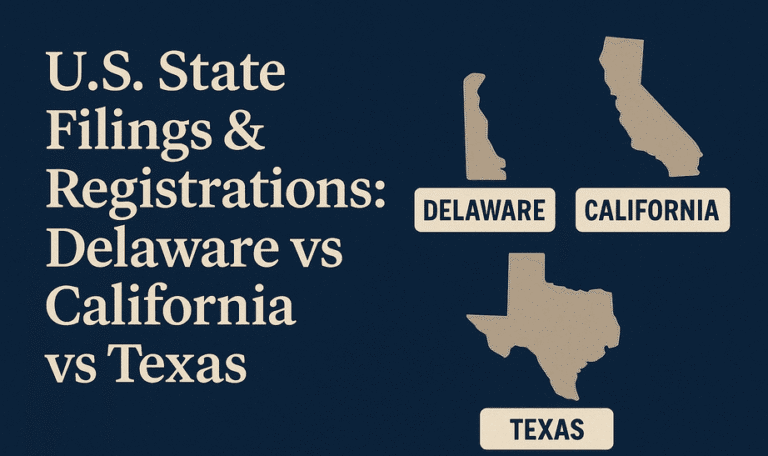
Delaware vs California vs Texas LLC: Which State Is Best in 2025?

Choosing between Delaware vs California vs Texas LLC is one of the most important decisions entrepreneurs make when forming a U.S. company in 2025. When you launch or expand a business in the United States, the state of incorporation can have a greater long-term impact than many founders realize. With business formation activity remaining historically high, the state you choose—among 50 jurisdictions with different tax rules, compliance costs, and legal frameworks—can significantly influence your operating costs, investor appeal, and regulatory burden. For entrepreneurs, including non-U.S. founders, deciding between Delaware, California, and Texas when forming an LLC can define the company’s trajectory from day one. This guide compares these three states and helps you align your choice with your business goals. The Macro Trend: What 2024–2025 Data Shows Despite economic uncertainty, U.S. business formation remains strong. According to the U.S. Census Bureau’s Business Formation Statistics, projected employer-business formations for July 2025 stood at 28,494, reflecting continued momentum. In 2024 alone, more than 5.2 million business applications were filed nationwide—one of the strongest years on record. Delaware continues to dominate as a corporate domicile. The Delaware Division of Corporations reported 289,810 new business-entity formations in 2024, nearly 73% of which were LLCs. As of the end of 2024, more than 2.1 million legal entities were registered in Delaware, including over 66% of Fortune 500 companies. For founders—especially those operating remotely or from outside the U.S.—this reinforces a key point: while the U.S. remains highly accessible for company formation, choosing the right state can materially reduce long-term costs and compliance friction. Delaware vs California vs Texas LLC — State-by-State Comparison Delaware: The Investor-Friendly Standard Delaware remains the default choice for venture-backed and high-growth companies. Its strength lies in the Delaware General Corporation Law (DGCL) and the Delaware Court of Chancery—a specialized, non-jury court known for predictable, business-oriented rulings. Forming an LLC in Delaware typically involves a filing fee of approximately US$90–$110 and a flat annual franchise tax of US$300. A registered agent with a Delaware address is required, but founders do not need to reside in the state. Member and manager details are not publicly disclosed, offering additional privacy. For businesses planning to raise institutional capital, scale aggressively, or pursue future acquisitions or IPOs, Delaware remains highly attractive. That said, 2025 has seen growing debate around whether Delaware should still be the automatic default for every business model. California: Market Access with Higher Compliance Costs California offers unmatched access to customers, talent, and innovation ecosystems. However, this access comes with higher ongoing costs. While the initial filing fee to form an LLC is relatively low (around US$70), every California LLC must pay a minimum annual franchise tax of US$800—regardless of revenue or profitability. Additionally, if an LLC is formed in another state but conducts business in California, it must register as a foreign LLC, appoint a local registered agent, and comply with California reporting requirements. As a result, California generally makes sense only when a company’s operations, workforce, or customer base are closely tied to the state and can justify the higher compliance burden. Texas: A Cost-Efficient, Business-Friendly Alternative Texas has emerged as a strong alternative for entrepreneurs seeking lower costs and operational flexibility. While Texas imposes a franchise tax, most small and mid-sized LLCs owe no tax if annual revenue remains below the US$2.47 million “no tax due” threshold (as applicable in 2024–2025). LLCs must still file an annual Public Information Report or Ownership Information Report, but Texas does not levy personal state income tax and generally maintains a business-friendly regulatory environment. These factors make Texas particularly attractive for remote-first, bootstrapped, and non-resident founder-led businesses. Case Study: Coinbase’s Move from Delaware to Texas In November 2025, Coinbase announced its decision to reincorporate from Delaware to Texas. Public filings cited a more favorable and predictable legal environment under Texas corporate law. While the company’s operations and public listing remained unchanged, the move reflects a broader trend: even large, established companies are reassessing Delaware as the default incorporation choice. For founders, this shift underscores the importance of aligning legal domicile with long-term strategy rather than relying on convention alone. Which State Should You Choose? Practical Scenarios Founders should also consider foreign-LLC registration requirements when operating outside their state of incorporation, as this can add unexpected compliance obligations. Conclusion: Delaware vs California vs Texas LLC — Final Verdict Ultimately, the choice between Delaware vs California vs Texas LLC depends on your growth ambitions, operational footprint, and tolerance for ongoing compliance costs. Texas offers a low-friction path for lean ventures, Delaware remains a trusted option for growth-focused companies, and California can be justified when market access clearly outweighs regulatory expense. A strategic incorporation decision at the outset can significantly reduce risk, control costs, and support long-term success. When launching or expanding a business in the United States, one of Ritu

GET IN TOUCH

Let's Get Started with Us, For Further Info.

Contact Us

    ©2023. All Rights Reserved.