
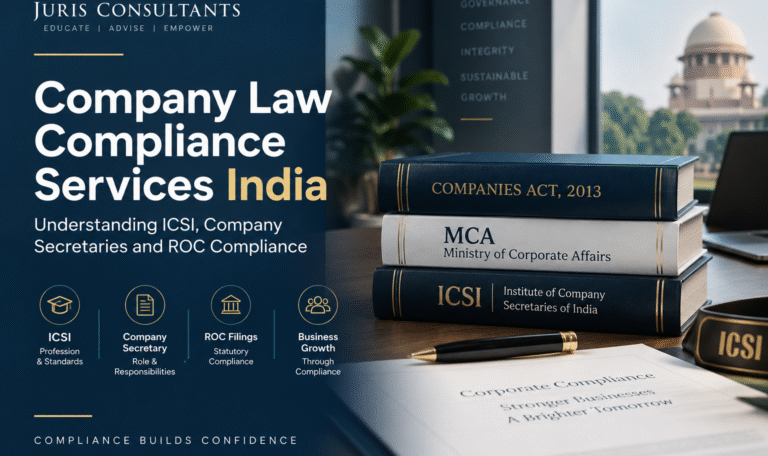
Company Law Compliance Services India: Understanding ICSI, Company Secretaries and ROC Compliance

Most founders do not think about compliance until it becomes urgent. A due diligence request, a bank loan application, a funding round, or a requirement to update company records can quickly expose gaps in statutory filings and documentation. These situations are avoidable when businesses maintain their company law compliance on a regular basis. Keeping statutory records, registers, board documentation, and required filings up to date makes compliance part of normal business operations rather than an emergency exercise. The Institute of Company Secretaries of India (ICSI) plays an important role in developing and regulating the Company Secretary profession in India. Understanding the role of ICSI, the responsibilities of a Company Secretary, and the importance of ongoing compliance can help growing businesses make better decisions about their statutory obligations. Why Company Law Compliance Services India Are Important When a company is incorporated under the Companies Act, 2013, its compliance responsibilities do not end with registration. Companies have continuing obligations toward the Ministry of Corporate Affairs (MCA). These obligations can include: Failure to meet applicable requirements can result in additional government fees, penalties, and other regulatory consequences. In certain circumstances and depending on the nature of the default, directors may also face personal consequences. This is why company law compliance services in India are more than an administrative function. Proper compliance can help businesses demonstrate that they maintain their statutory responsibilities to investors, lenders, and potential business partners. A business with organized records and a consistent compliance history may also be better prepared for due diligence, financing discussions, and other important corporate events. What Is the Institute of Company Secretaries of India (ICSI)? The Institute of Company Secretaries of India (ICSI) is the professional body responsible for developing and regulating the Company Secretary profession in India. ICSI is involved in areas such as: The institute helps establish the professional framework within which Company Secretaries provide governance and compliance support to Indian companies. For businesses, this means that a Company Secretary working internally or through a professional service provider operates within professional standards established by ICSI. What Does a Company Secretary Do? The role of a Company Secretary extends beyond preparing documents. A Company Secretary can assist a company with corporate governance, statutory compliance, and regulatory documentation. Depending on the company’s requirements, responsibilities may include: For many small and medium-sized businesses, hiring a full-time Company Secretary may not always be the preferred approach. Company secretarial services in India can provide businesses with professional compliance support without necessarily requiring a full-time internal resource. The appropriate arrangement depends on the company’s structure and applicable legal requirements. What Is ROC Compliance? The Registrar of Companies (ROC) is an important part of India’s corporate regulatory framework. ROC-related compliance can include annual filings, financial statement filings, director KYC requirements, and event-based filings when certain changes occur. Examples of events that may require corporate filings include: Keeping track of these requirements is important because late filings can result in additional government fees and may create compliance gaps. Reliable ROC filing services in India can help businesses monitor applicable deadlines and maintain their filing records. Company Law Compliance for Small Businesses in India Startups and small businesses often prioritize growth, sales, hiring, and fundraising while treating compliance as something that can be handled later. This can create unnecessary problems. Even smaller private companies can have continuing statutory obligations. Attempting to catch up on several years of filings and corporate records can be considerably more complicated than maintaining compliance from the beginning. Founders can reduce this administrative burden by establishing basic compliance processes early, including: A consistent compliance process can also make future fundraising, due diligence, financing, or acquisition discussions more organized. How Professional Compliance Consultants Can Help Managing corporate compliance can become difficult when multiple filing deadlines, documents, and regulatory requirements need to be monitored simultaneously. Professional company law and secretarial compliance services can help businesses create a structured compliance process. Depending on the company’s needs, professional support may include: A well-managed compliance process reduces dependence on someone simply remembering deadlines manually. Because MCA rules, forms, and requirements can change, periodic professional review can also help businesses identify requirements that may otherwise be overlooked. Common Business Compliance Mistakes to Avoid Businesses of different sizes can encounter similar compliance problems. Some common mistakes include: 1. Missing filing deadlines Late filings can result in additional costs and create unnecessary compliance issues. 2. Failing to maintain proper records Corporate decisions, meetings, registers, and statutory documentation should be maintained appropriately. 3. Relying on verbal board decisions Important corporate decisions should be properly documented rather than relying only on verbal discussions. 4. Treating compliance as an annual activity Not every compliance requirement is annual. Some obligations are event-driven, meaning they can arise when a company takes a particular action or experiences a specific change. 5. Delaying compliance until a transaction is approaching Trying to correct several years of records before a funding round, acquisition, loan, or due diligence exercise can create unnecessary pressure. A continuous compliance approach is generally more organized than treating compliance as an emergency task. Company Secretary vs Company Director: What’s the Difference? Although Company Secretaries and Company Directors both play important roles in corporate governance, their responsibilities are different. Responsibility Company Secretary Company Director Governance oversight Advises on and documents governance practices Sets strategic direction and approves policies Statutory compliance Manages day-to-day compliance execution Ultimately accountable for compliance outcomes ROC filings Prepares and files applicable statutory forms Signs off on filings as an authorized signatory where applicable Board meetings Schedules, documents, and maintains minutes Attends, deliberates, and votes on resolutions Statutory records Maintains registers and secretarial records Reviews and relies on records for business decisions Decision-making Provides procedural and regulatory guidance Makes final business and strategic decisions Legal accountability Professionally accountable for compliance accuracy May be personally liable for certain statutory defaults, depending on the circumstances The exact responsibilities and legal obligations can vary depending on the company’s structure and the applicable provisions of law. Frequently Asked Questions About Company Law..

How to Choose a Legal and Tax Advisor for Your Business

Choosing the right legal and tax advisor for your business can help you avoid costly compliance mistakes, manage risk, and make better decisions as your company grows. Whether you are launching a startup, preparing for fundraising, expanding into new markets, or managing ongoing compliance, the right professional support can make a significant difference. Why Does Your Business Need a Legal and Tax Advisor? Many founders look for a legal or tax advisor only when a problem arises. This could be a funding round that requires a shareholder agreement, a compliance notice that needs immediate attention, or an ESOP plan that has not been properly documented. Waiting until these situations occur can lead to rushed decisions and unnecessary costs. As a business grows, the consequences of compliance mistakes can also become more serious. A delayed ROC filing may be manageable during the early stages but could create complications during investor due diligence or a funding round. A reliable legal and tax advisor for business can help with: The goal is not simply to find the most expensive advisor. It is to find a professional whose expertise matches your business stage and requirements. Legal Advisor vs Tax Advisor: What Is the Difference? The terms lawyer, Chartered Accountant, Company Secretary, tax consultant, and business consultant are sometimes used interchangeably. However, each professional has a different area of expertise. Corporate Lawyer A corporate lawyer can help businesses prepare and negotiate contracts, shareholder agreements, corporate documentation, regulatory matters, and dispute-related issues. Chartered Accountant A Chartered Accountant, or CA, generally handles areas such as accounting, financial statements, audits, tax filings, and financial compliance. Company Secretary A Company Secretary, or CS, focuses on corporate law compliance, including statutory filings, board documentation, shareholder matters, and other company law requirements. Tax Consultant A tax consultant specializes in tax planning, tax compliance, and related direct or indirect tax matters. Intellectual Property Professional An IP professional can assist with trademarks, patents, copyrights, designs, and intellectual property protection. Understanding these differences helps business owners select the right professional instead of paying for expertise they do not currently need. Law Firm vs Online Compliance Platform One common question among startup founders is whether they should hire a law firm or use an online compliance platform. There is no single answer. The right choice depends on the complexity and stage of your business. An online compliance platform can be useful for routine registrations, basic filings, and standardized compliance requirements. These services can offer predictable processes and lower costs for straightforward requirements. A law firm may be more appropriate when your business needs customized legal advice, contract negotiation, shareholder agreements, fundraising support, dispute assistance, or complex corporate structuring. In many cases, businesses use both. A startup may begin with an online platform for routine compliance and later engage a law firm when its legal requirements become more complex. Questions to Ask Before Hiring a Legal or Tax Advisor Before signing an engagement with an advisor, ask clear questions about their expertise, pricing, communication, and scope of work. Consider asking: The answers can help you evaluate whether the advisor is a suitable long-term partner. Corporate Legal, Tax and IPR Terms Every Founder Should Know A basic understanding of corporate, tax, and intellectual property terminology can make conversations with professional advisors much easier. This corporate legal tax IPR glossary India covers some common terms founders should understand. FEMA The Foreign Exchange Management Act (FEMA) regulates certain foreign exchange transactions and foreign investment activities involving India. NCLT The National Company Law Tribunal (NCLT) is a specialized forum dealing with various matters relating to company law and insolvency proceedings. SAT The Securities Appellate Tribunal (SAT) hears appeals against certain orders issued by securities market regulators such as SEBI. ROC and MCA The Registrar of Companies (ROC) is responsible for receiving statutory company filings. The Ministry of Corporate Affairs (MCA) oversees India’s corporate regulatory framework and the ROC system. DIN A Director Identification Number (DIN) is a unique identification number associated with a director of a company. DSC A Digital Signature Certificate (DSC) is used for digitally signing certain documents and filings submitted to government authorities. GST Goods and Services Tax (GST) is an indirect tax applicable to the supply of goods and services under India’s GST framework. TDS Tax Deducted at Source (TDS) requires tax to be deducted from certain payments and deposited with the government as prescribed by applicable tax rules. ESOP An Employee Stock Option Plan (ESOP) allows eligible employees to receive options to purchase shares of a company, subject to the applicable terms and legal and tax requirements. IPR Intellectual Property Rights (IPR) protect creations such as trademarks, patents, copyrights, and designs. Businesses should consider IP protection early, particularly when developing a brand, product, or technology. This startup legal terms glossary provides only a basic introduction. Businesses should seek professional advice when specific legal, tax, or regulatory decisions are involved. Common Mistakes Businesses Make When Choosing an Advisor Businesses often make avoidable mistakes when selecting professional advisors. Choosing an Advisor Based Only on Price The cheapest provider may not have the expertise your business requires. At the same time, paying for specialized expertise that you do not need may unnecessarily increase costs. Waiting Until There Is a Problem Establishing a relationship with an advisor before a compliance issue or funding round can give your business more time to prepare. Choosing a Generalist for a Specialized Requirement A general business consultant may not be the right professional for specialized areas such as intellectual property protection, corporate restructuring, or cross-border transactions. Not Having a Clear Engagement Letter An engagement letter should clearly define the scope of work, fees, responsibilities, timelines, confidentiality requirements, and procedures for additional work. Not Discussing Communication Expectations Response times, points of contact, and communication methods should be established before the engagement begins. How to Build a Long-Term Advisory Relationship Your business needs can change significantly as the company grows. A startup may initially need help with incorporation, tax registration, and routine compliance. Later,..

How to Draft a Shareholders Agreement That Prevents Future Disputes

A shareholders agreement is designed to establish clear rules for shareholders and reduce the risk of disputes before they arise. For founders, investors, and growing companies, a well-drafted agreement can clarify what happens when a shareholder wants to exit, when shareholders disagree, or when the company needs additional funding. Many founders use generic templates when starting a business because they want to control costs. However, a template may not address the specific ownership structure, business model, funding arrangements, or future risks of a company. That is why drafting a shareholders agreement carefully at the beginning can be far more effective than trying to resolve disagreements after they become formal disputes. A corporate litigation lawyer in India can help founders identify potential areas of conflict and build appropriate mechanisms into the agreement before problems arise. What Is a Shareholders Agreement? A shareholders agreement is a contract between the shareholders of a company that sets out their rights, responsibilities, obligations, and arrangements concerning the company. It can address matters such as: The Companies Act and the company’s articles of association provide the basic legal framework for corporate governance. However, shareholders may also require specific contractual arrangements dealing with founder relationships, investment terms, exits, and other commercial matters. A carefully drafted agreement can therefore reduce uncertainty and provide a clear process when shareholders disagree. What Is a Shareholders Agreement Meant to Prevent? Founders often create a company with a shared vision. However, circumstances can change as the business grows. For example: These questions may seem hypothetical when a company is first established. However, addressing them in advance can prevent uncertainty from becoming a commercial dispute. The purpose of a shareholders agreement is not to eliminate every disagreement. Instead, it provides a framework for dealing with foreseeable disagreements in a structured manner. Why Generic Shareholders Agreement Templates May Fall Short A generic template may cover basic ownership and governance provisions, but it may not reflect the actual risk profile of a particular business. For example, a company with two equal founders may require a detailed deadlock mechanism. A startup with one controlling founder and several investors may need provisions dealing with minority rights, preferred terms, board representation, and investor protections. Similarly, the agreement for a closely held family business may look very different from the agreement used by a venture-backed startup. Therefore, treating a shareholders agreement as a document that simply needs to be signed and filed away can create problems later. The agreement should reflect the company’s: Important Clauses in a Shareholders Agreement The most effective shareholders agreements address the situations that are most likely to create disagreement. 1. Exit and Buyout Mechanisms One of the most important issues to address is what happens when a shareholder wants to leave the company. A well-drafted agreement can establish: Without a clear mechanism, the departure of one shareholder can quickly become a dispute over valuation. By establishing the process in advance, shareholders have a defined framework to follow when an exit occurs. 2. Deadlock Resolution Deadlocks can become particularly difficult when shareholders have equal or substantially equal ownership. For example, two founders may disagree about: If neither shareholder has sufficient voting power to resolve the disagreement, the company’s decision-making can become paralysed. A shareholders agreement can include a deadlock resolution mechanism. Depending on the circumstances, this may involve: The mechanism should be selected carefully based on the company’s ownership structure and commercial requirements. 3. Drag-Along and Tag-Along Rights Share transfers can create significant issues when majority and minority shareholders have different objectives. A drag-along right can allow qualifying majority shareholders to require minority shareholders to participate in a sale of the company, subject to the agreed terms. A tag-along right, on the other hand, can protect minority shareholders by allowing them to participate in a sale when majority shareholders sell their shares to a third party. These provisions can help provide clarity during a future sale or investment transaction. The exact drafting of these clauses is important because the rights, thresholds, notice requirements, and transaction terms should be clearly defined. 4. Dispute Resolution Clause The dispute resolution clause deserves particular attention. A vague clause referring only to “arbitration in Delhi,” for example, may leave important questions unanswered. A carefully drafted clause should consider matters such as: A properly structured dispute resolution mechanism can reduce uncertainty if a disagreement eventually becomes a formal dispute. An arbitration lawyer in India can assist companies in structuring dispute resolution provisions that are appropriate for their particular arrangements. Common Mistakes Founders Make When Drafting a Shareholders Agreement Even when founders understand the importance of having an agreement, several drafting mistakes can create problems later. Signing the Agreement Before the Cap Table Is Finalised An agreement drafted before a funding round is completed may require significant changes once new investors enter the company. New investors may negotiate: If these provisions are introduced after the original agreement has already been signed, the company may end up with multiple amendments that are difficult to reconcile. It is generally better to ensure that the shareholders agreement reflects the company’s actual ownership and investment structure. Treating Confidentiality and Restrictive Covenants as Boilerplate Confidentiality provisions can be important when founders and shareholders have access to commercially sensitive information. However, restrictive covenants, including non-compete provisions, require careful drafting because their enforceability can depend on the wording, circumstances, and applicable Indian law. A provision that is excessively broad may create enforceability concerns. The objective should therefore be to draft restrictions carefully and in a manner appropriate to the company’s circumstances rather than simply inserting a generic clause. Failing to Address an Inactive Shareholder A founder may stop actively contributing to the company while retaining a substantial equity interest. This can create significant tension among the remaining founders. Depending on the company’s structure and applicable arrangements, the agreement may address this through mechanisms such as: These provisions should be drafted carefully because they can have significant commercial and legal consequences. What Happens When a Shareholder Dispute Still Occurs?..

How to Renew a Trademark Registration in India

A trademark is not a “file and forget” asset. Once registered, a trademark in India is generally protected for 10 years, after which it must be renewed to maintain protection. For businesses, a trademark can represent years of investment, customer recognition, and brand reputation. Missing a renewal deadline can therefore put valuable brand protection at risk. In this guide, we explain how to renew a trademark registration in India, when you should apply, what happens if you miss the deadline, and why professional assistance can help businesses manage their trademark portfolio effectively. Why Is Trademark Renewal Important? A registered trademark gives its owner legal protection over the mark in connection with the goods or services for which it is registered. However, this protection is not indefinite. A trademark registration in India generally needs to be renewed every 10 years. If the trademark is not renewed within the prescribed period, it may eventually be removed from the Trademark Register. This can create unnecessary risks for a business, particularly if another party attempts to register or use a similar mark. For this reason, trademark renewal should be treated as an important part of ongoing trademark compliance. Key benefits of timely renewal include: For businesses that have invested heavily in developing their brand identity, timely renewal is an important preventive step. When Does a Trademark Registration Need to Be Renewed? Under Indian trademark law, a trademark registration is generally valid for 10 years from the date of application and can be renewed for further periods of 10 years. Trademark owners should therefore identify the renewal date well in advance. The Trademark Registry may issue a reminder before the registration expires. However, businesses should not depend solely on receiving a reminder. Contact details may change, notices can be overlooked, and internal responsibility for intellectual property matters can shift over time. A better approach is to maintain an internal trademark calendar and record: This becomes particularly important when a business owns several trademarks across different classes. How to Renew a Trademark Registration in India The Trademark Registration process for renewal is generally more straightforward than the process of obtaining a new registration. The following steps provide a general overview. 1. Check the Trademark Registration Details Before filing for renewal, verify the trademark’s: This helps identify discrepancies that may need to be addressed before or during the renewal process. 2. File Form TM-R Trademark renewal is generally carried out by filing Form TM-R with the Indian Trade Marks Registry. The application can be filed through the applicable IP India filing system or through the prescribed filing mechanism. The application should contain accurate details of the registered trademark and proprietor. 3. Pay the Applicable Government Fee The prescribed trademark renewal fee must be paid along with the application. The applicable fee can depend on factors such as: Because government fees and filing procedures can change, applicants should verify the current fee schedule applicable at the time of filing rather than relying on outdated figures. 4. Renewal by the Trademark Registry Once the renewal application and applicable fee have been submitted, the Trademark Registry processes the request. Unlike a new trademark application, a routine renewal generally does not involve repeating the entire examination and publication process associated with the original registration. Once renewed, the trademark can continue for another 10-year period, subject to the applicable law and renewal requirements. What Happens If You Miss the Trademark Renewal Deadline? Missing the original renewal deadline does not necessarily mean that the trademark is immediately lost. Indian trademark law provides mechanisms for renewal after expiry, subject to the applicable statutory period and additional fees. Therefore, if a trademark has already expired, the owner should act promptly rather than assuming that the registration is permanently lost. However, allowing the registration to lapse can create additional complications and costs. Why delayed renewal can be risky During a period in which the trademark’s registration is not effectively maintained, the business may face increased uncertainty regarding its brand protection. There is also a possibility that another party may attempt to file an application for an identical or similar mark. For an established business, such a situation can lead to unnecessary legal and commercial complications. Can a Removed Trademark Be Restored? In certain circumstances, Indian trademark law provides a mechanism for restoration of a trademark that has been removed from the Register. Restoration is different from ordinary renewal and may involve additional requirements, fees, and scrutiny. The exact procedure and applicable timelines depend on the circumstances of the registration and the relevant provisions in force at the time. Therefore, businesses whose trademarks have already been removed should seek professional advice promptly rather than assuming that restoration will automatically be granted. Trademark Renewal vs. New Trademark Registration It is important to understand the difference between renewing an existing trademark and applying for a new trademark. Trademark Renewal New Trademark Registration Applies to an existing registered mark Applies to a new trademark Generally uses Form TM-R Generally begins with Form TM-A Extends the existing registration Creates a new registration Does not normally repeat the entire examination process Involves examination by the Registry Primarily concerns continuation of protection Requires the complete registration process Generally simpler than a new application Can involve examination, publication and opposition Understanding the distinction can help businesses plan their intellectual property strategy more effectively. Understanding Trademark Registration Cost and Process in India Businesses often search for trademark registration cost and process in India when they are considering brand protection for the first time. The initial trademark registration process generally involves several stages, including: Trademark renewal is different because the mark has already gone through the registration process. However, businesses should remember that trademark protection does not end with registration. Ongoing monitoring, renewal and enforcement are also important components of trademark management. What If There Is a Trademark Objection or Conflict? Trademark-related issues can sometimes go beyond renewal. For example, a business may receive an examination objection, encounter a conflicting trademark application, or face another..

GET IN TOUCH

Let's Get Started with Us, For Further Info.

Contact Us

    ©2023. All Rights Reserved.